

Historical epics are a way in which societies reinforce their identity, often nurturing nationalism through a semi-mythological retelling of history which typically reflects the time these films were made as much as the time they are about. The United States has its Westerns, movies about the conquest of the frontier- manifest destiny for the drive in. Yugoslavia had its Partisan films, glorifying the heroes who fought the axis during the second world war.
As far-right narratives become more influential it’s unsurprising that a small collection of historical films that dramatise a ‘clash of civilisations’ between the Islamic world and the West is starting to gain recognition among adherents of the movement. Despite increasing electoral success and the backing of the world’s richest man the western far-right has not yet created its own significant cultural canon, instead appropriating existing works. For example, Italian Prime Minister Giorgia Meloni’s appreciation for the Lord of the Rings.
Films for the alt-right canon have to be recontextualised from their original purpose. El Cid (1961) which tells the (largely fictionalised) story of Rodrigo Díaz de Vivar (c. 1043–1099) better known as ‘El Cid’ (derived from the Arabic ‘sayyid’, or ‘lord’) who was a mercenary and warrior who fought on behalf of both Muslims and Christians in the Iberian peninsula, but is today associated with fighting against Muslim ‘invaders’ is a clear candidate. Yusuf ibn Tashufin, the Muslim antagonist of the film, asserts that the prophet has ordered them to rule the world and declares that to achieve that aim, they will first sweep across Spain, then Europe. It’s a narrative that certainly suits today’s far-right, though the film was made (with the support of Francisco Franco) in an era where this was used more as a metaphor for the threat of communism spreading across Europe. Not to mention that the film’s communist screenwriter may have intended it to be a civil rights allegory.
The Battle of Kosovo (1989) was created explicitly to promote the clash of civilisations narrative, with director Zdravko Šotra stating that he wanted his film to highlight the importance of the Serbs as a bulwark to protect Europe against the Ottoman Turks. The film was originally made primarily for a Serbian audience, but with the goal of reaching a wider European one—a goal that has only been achieved in more recent years. I suspect that the film’s revival online reflects the incorporation of the Serbian propaganda, which led to the ‘ethnic cleansing’ of Bosnia and Kosovo in 1990s, into contemporary far-right discourses.
Historian Radina Vučetić writes that what she has termed “the Kosovo myth” of which the 1989 film is a key part, “is always present and may be “reactivated” for political purposes at any time”. The film was rebroadcast at the very beginning of the 1999 NATO bombing of Kosovo (24 March 1999) and again as recently as 2020 following the announcement of a state of emergency in Serbia due to the coronavirus pandemic. She describes this use of nationalist myth to fight a virus as “really the peak of absurdity” but this recent broadcast demonstrates the film’s contemporary relevance to nationalist narratives in Serbia.
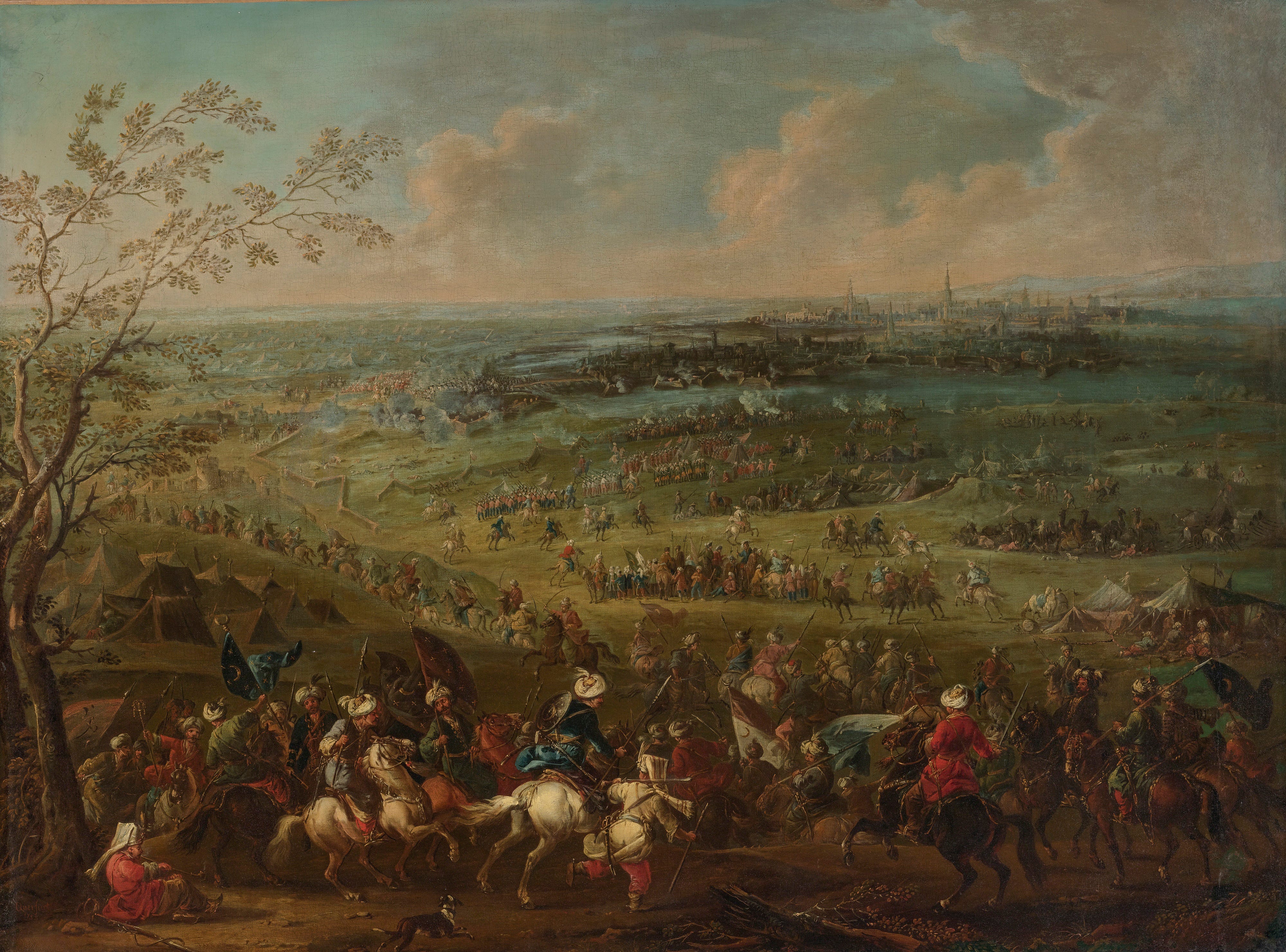
Day of the Siege (2012), a dramatisation of the 1683 Battle of Vienna, is an Italian and Polish co-production but was shot in English to appeal to a broad audience. 10,000 extras and 3,000 horses were used for battle scenes. It’s a satisfactory enough movie (even if the visual effects look like a video game cutscene) but its political ideology is clear. To give one example, Abu’l, a muslim character living in Austria (played by Greek actor Yorgo Voyagis) ultimately betrays his wife and his country for his religion- a not so subtle suggestion that muslims living in the west will never truly be part of it.
The film does not have a mainstream distributor and instead was distributed in North America by the Catholic publishing house Ignatius Press, under the alternative title The Siege of Vienna: September 11, 1683. The distributor describes it as an epic that “tells the powerful true story of one of the most important military battles in history, recounting the Ottoman Turks massive invasion of Vienna, the gateway to the West, on September 11, 1683, a moment when Christendom and Western civilization truly hung in the balance.” The battle of Vienna has been described as “central to the far-right historical imaginary”.
The historical events depicted in the film (not the film itself, which was released a year later) inspired Norwegian terrorist Anders Brevik, who titled his manifesto 2083: A European Declaration of Independence, referencing what will be the 400th anniversary of the Ottoman defeat at Vienna. Şener Aktürk, a scholar of comparative politics with a particular focus on ethnicity, religion, and nationalism, describes the idea of a specifically Christian European civilisation as “a malicious and mythical claim that has been calamitously employed throughout history in most episodes of ethnic cleansing against non-Christians in Europe, from the expulsion of Jews and Muslims from Spain in 1492 to the genocidal campaign against Bosnian Muslims in the 1990s”. This provides an important context for examining the 2012 film. Citing research from historian Timothy Snyder, Aktürk goes on to say “One would think this episode could be easily characterised as a clash between Muslims and Christians, but in fact it cannot.”
Aktürk recounts his own encounter with the siege of Vienna, when as a student at the University of Chicago he participated in a study abroad program on “Western Civilization” in the aftermath of the September 11 2001 terrorist attacks on the United States.
“Our tour guide was an Austrian monk who spoke impeccable American English, since he was also a graduate of a leading American university. In the middle of the tour, he stopped in front of a cracked wall and told us that the wall crack was the result of the siege of Vienna by the “Turks” in 1683: A catapulted stone cracked the wall, and a frame was put around the crack as a constant “reminder to us,” he said, “of who the enemy of the Church is.” From the tone of his voice though, it did not sound as if he needed a reminder. He then dramatically concluded: “And this is the struggle we are still fighting today, with the September 11 attacks in New York.””
The 1683 siege of Vienna and 2001 terror attacks both occurring on September 11 is no coincidence. The date of the latter was chosen to reference the former. There is a commonality between the narratives of both Islamic extremists and the far-right, as Julia Ebner writes in her 2017 book The Rage: The Vicious Circle of Islamist and Far-Right Extremism
“Extremists have been good at delivering consistent narratives – simplicity of their story forms helps. In fact, their stories do not just make sense in themselves; they are also consistent with the other extreme’s worldview. There is therefore an intra-extremist narrative compatibility that creates a bizarre symbiosis between opposing extremes. Whether you are on the side of the light or the dark side in Star Wars does not really change the story; the only thing that does change is the perspective. The same is true for the far-right and Islamist extremists – they are in the same movie, reinforcing the same story and thus helping each other as storytellers. While Islamist extremists tell us that the ‘West is at war with Islam’, the far right tells us ‘Islam is at War with the West’. While far-right groups tend to see Islam as the only problem, Islamist extremists view Islam as the only solution. One only needs to reverse protagonist and antagonist or exchange problem and solution to see that their narratives are perfectly complementary, if not identical”
Ebner terms this the Star Wars effect, noting that this black-and-white way of seeing the world is common across popular cinema. “A look at the most popular movies in history is enough to see that we love binary worldviews: for example, the Star Wars cosmos divides the world into the light and the dark side of the force. James Bond, Indiana Jones, American Sniper, and even Kung Fu Panda, do nothing else. In a way they all tell the same story based on different characters and embedded in different contexts.”
Real history of course is never this simple. The reasons Şener Aktürk rejects the idea that the Siege of Vienna was a clash between Christendom; The battle was the culmination of events that began when Imre Thököly, a Hungarian Protestant statesman called on his allies, the Ottomans, to organise a campaign against the Catholic Habsburgs. Thököly’s kingdom of upper Hungary (today, mostly Slovakia) became an Ottoman vassal state, with the sultan granting a degree of religious freedom for the Protestants that the Papal states would not. “The Protestant countries would have gladly seen the Holy Roman Empire fall to the Ottomans” writes historian Dag Herbjørnsrud.
Seeing the war as one fought between Protestants and their Muslim allies against Catholic powers is however also an oversimplification. Louis XIV, the Roman Catholic king of France, wanting to become the most powerful Christian monarch in Europe, was allied with the Ottomans, and sent troops to the western front as the Ottoman army closed in around Vienna. His enemies referred to him as “the most Christian Turk”. And when the Catholic Polish king John III Sobieski came to the aid of the Habsburg monarchy, he did so with the help of Sunni Muslim Tatars, a Turkic ethnic group who resided in the Polish–Lithuanian Commonwealth. Sobieski later ensured construction of several mosques in the region, which still stand. Historian Boguslaw R Zagórski credits Sobieski with securing “the only example of a lasting Muslim community in a non-Islamic European country”. For centuries the Lipka Tatars were a vital part of Polish battles. As late as 1939, the 1st Tatar Squadron was among the last Polish army units fighting invading infantry of Nazi Germany. When a monument to the Tartars was dedicated in 2010, Polish president Bronisław Komorowski declared “There was no enemy of Poland against whom they did not draw their weapons for the good of their motherland. They fought and forced out Russians, Swedes and even Turks despite their common religion – Islam.”
The Tatars are absent from the film, and under-recognised in other modern media that tells stories of the siege. The 2018 song ‘Winged Hussars’ by Swedish power metal band Sabaton celebrates the role of the Polish heavy cavalry, but the episode of their Sabaton History YouTube channel that talks about the battle of Vienna only mentions the Tatars in the context of “invasions from the east”, not as a group who fought alongside the hussars. On the trailer for Day of the Siege among the most highly upvoted comments are the phrases “Then the winged hussars arrived!” and “We Remember! In September! When the winged hussars arrived!”, lyrics from the song.
The perpetrator of the Poway, USA synagogue shooting in April 2019 had a playlist (allegedly made for the occasion) which included the Wings Hussars. According to Phillip Stenmann Baun, a research fellow at Aarhus University, in the shooter’s use of this song “we see fragments of the same historiographic consciousness that [Brenton] Tarrant espoused”. While their lyrics glorify the military might of the Polish Hussars, Sabaton would likely not endorse the appropriation of their lyrics for these ends- singer Joakim Brodén has previously described the band as “fucking pissed off” when a Polish far-right party used their music for an election campaign.
It’s possible that as the far-right gains more power and influence throughout Europe we will start to see more cinematic retellings of history that portray history in a way that serves the interests of the powerful- as we’re already seeing in India. Historians have an important role to play in raising awareness of the real history of Islam and the west.