

Planning this article I kept thinking of the first words in the famous monologue from the 1976 film Network. “I don’t have to tell you things are bad. Everybody knows things are bad.” Unlike Peter Finch’s Howard Beale, I’m not going to exhort you to go to your window and yell about how you’re mad as hell, and not going to take it anymore. Speakers with a media platform encouraging their audiences to anger is, after all, a big part of how we got into this mess.
Writing Fear I was watching places that few others were (not no others- and the journalists I list in the acknowledgements deserve a lot of credit for their work.) I’d long been watching fringe online spaces and media, weird fascistic sects, and those oddball political parties that barely registered in polls, when suddenly the moment came where a book about those things was something people felt was important to read after people from that milieu occupied parliament grounds in opposition to vaccine mandates and a grab bag of other grievances.
I had, of course, plenty of critics. Among some audiences, I was seen as a paranoid conspiracy theorist seeing fascists around every corner. Some people felt that by writing about these groups I was giving them attention, when if I ignored them they would be no threat. I always pushed back on that one, as for one thing, far-right influencers on platforms like YouTube had much larger audiences than I did, and for another, ignoring the growth of the far-right online in the 2010s didn’t stop a radicalised terrorist from murdering 51 people in my home town.
That terrorist has been in the news lately as he tries to appeal his conviction, in what will almost certainly be a futile effort. In his high security prison cell, he receives little information about the outside world. I wonder sometimes, does he know that in the USA, a masked paramilitary force is arresting, detaining, and deporting non-white immigrants? Does he know that in the UK, polls suggest the next government will likely be led a party who plans to build “removal centres” in remote areas of the country in order to detain up to 24,000 people as they carry out the mass deportation of 600,000 people? (while promising to leave the European Convention on Human Rights, which would otherwise offer those people some protection)
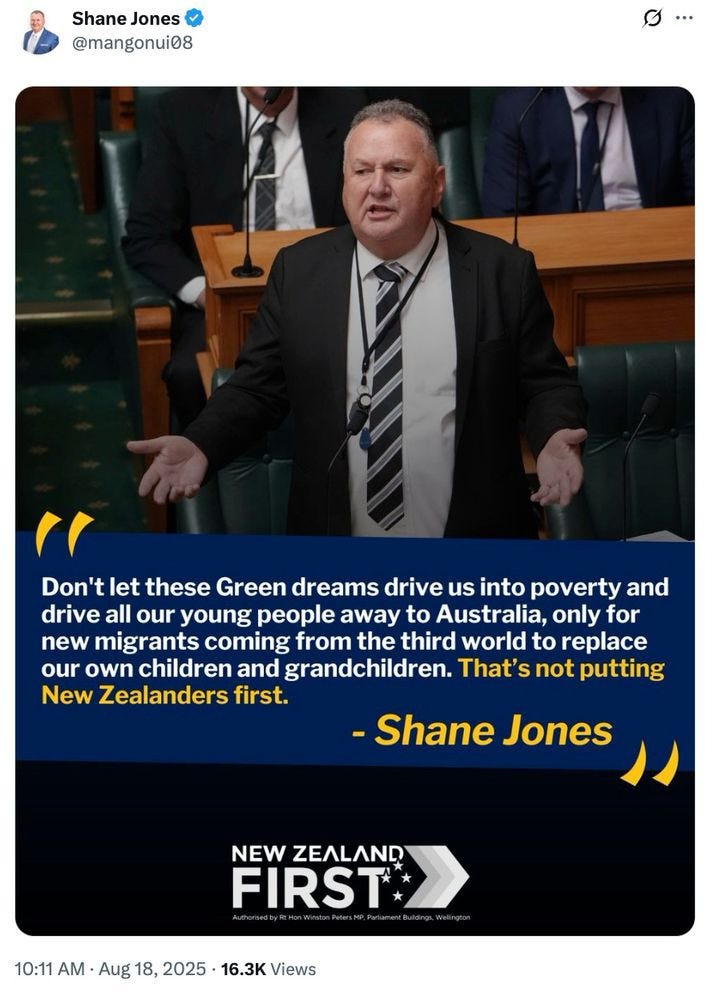
Has he become aware, from the small amount of news material he is permitted to see, that far-right parties are surging across continental Europe. Does he have any inkling that the beliefs he outlined in his manifesto are no longer confined to seediest parts of the web but are now openly discussed and algorithmically promoted on a social media platform owned by the world’s richest man, fueling anti-migrant and anti-Muslim violence? Or that New Zealand politicians have begun dogwhistling to believers in the “great replacement” conspiracy theory from which his manifesto took its name?
In my ‘one year on’ and ‘two years on’ articles I went through chapter-by-chapter, condensing a few chapters in the ‘two years on’ article. This year I’ll instead group chapters thematically. I’m not updating anything on Action Zealandia (chapter 3) as the organisation appears to be moribund. The former branches are operating autonomously with names like ‘Canterbury Legion’ and while their [ex]members are unpleasant people (one former AZ member recently assaulted two people with his car) they’re not having any significant impact on the nation’s body politic.
I also feel there isn’t much I could add to what I think of as ‘the history chapters’ (18 and 19) looking at colonisation, the white New Zealand policy, and nostalgia for Rhodesia and apartheid era South Africa. All I’d say regarding the role of women in the modern far-right (chapter 20) is that the podcast series ‘Truely, Tradly, Deeply’ makes a subscription to Cursed Media worth the price.
#Gamergate, Qanon, Disinformation and online hate
(chapters 1,2,4,5, and 9)
I’ve, on numerous occasions now, spoken of a ‘perpetual gamergate’ the original campaign is gone, but the methods and tactics- harassing a critic until you push them out of public life- have become normalised. The same is increasingly true of Qanon. While the largely online movement associated with the initial ‘Q’ conspiracy theory scene seems dated, if ‘Qanon’ has disappeared it’s because, like gamergate before it, it’s become how politics is done. Last October, Art Jipson, Associate Professor of Sociology at the University of Dayton, wrote:
“Over time, what started as a baseless conspiracy on obscure platforms has migrated into the mainstream. It has influenced rhetoric and policy debates, and even reshaped the American political landscape.”
In Aotearoa New Zealand last year we saw the influence of the methods and discourses of both gamergate and qanon in the campaign to destroy the political career of Benjamin Doyle, the country’s first openly non-binary member of parliament.
Disinformation and hate moving from the fringes to being promoted by those in power isn’t new. In Fear I used the campaign against the UN global compact on safe, regular and orderly migration as a case study. This sort of thing is happening writ large in the United States. As a recent New York Times article put it
“The influencers behind some of the most pernicious digital lies, who once toiled in the dark corners of the internet, are now emboldened, promoted on major platforms and even mimicked by some of the most powerful people in the country.”
Local examples continue to be seen. The campaign against Doyle may have remained confined to the hateful nooks of X if not for the involvement of NZ First leader Winson Peters.
The religious right
(chapters 6,7, and 17)
In 2024 the Sons of the Most Holy Redeemer, the fringe Catholic sect whose Latin mass I attended while researching the book, were ordered by the bishop (on Vatican advice) to leave the Christchurch Catholic diocese. That order was later rescinded, but the Sons were forbidden from celebrating Mass or conducting any other “priestly ministry” for anyone outside their religious community. They refused to leave the city, and described the actions of Church leaders, including the late Pope Francis, a critic of the traditionalists in the Church, as “evil”. The Vatican is still keeping an eye on the group.
The latest front group for the overtly Christian Nationalist Destiny Church is called ‘True Patriots of NZ’. On Facebook, where they have nine thousand followers, they describe themselves as “Guardians of the Kiwi Way of Life.” and “Defenders of Faith, Flag & Family.” Encouraging followers to “Join the movement standing against globalism, mass immigration, and woke ideology.” The group has taken particular aim at Auckland’s sikh community, disrupting religious processions carrying a banner proclaiming “This is New Zealand not India”.
Indian New Zealanders now make up the country’s third largest ethnic group. While this makes them a target of xenophobia from groups like the True Patriots, there are various Indian diaspora organisations in Aotearoa New Zealand (namely, Hindu Swayamsevak Sangh New Zealand, the Hindu Council of New Zealand and Overseas Friends of BJP New Zealand) which operate to propagate the Hindutva project, a form of nationalism which has seen violence against Muslims, Christians and other minority groups in India.
There is, of course, an anti-Hindutva current among the diaspora here. Sneha Singh at the University of Auckland has been researching that movement. One prominent anti-Hindutva activist was stripped of her Overseas Citizen of India status last year, suggesting goings on in this part of the world are not unnoticed by the Modi regime.
Fringe parties
(chapters 8, 10, and 12)
Following the True Patriots protest Brian Tamaki urged followers to withhold their votes in this year’s election. Although at the time of writing, the Destiny Church affiliated Vision New Zealand Party is still registered to be on the ballot. The party formerly known as the New Conservatives, who saw their vote collapse in 2023 (likely because NZ First took on a number of their policies, candidates, and members) has dropped the ‘new’ prefix and will contest this year’s election as The Conservatives, giving an option to those who think NZ First is still just a bit too woke.
New Zeal, who probably contributed to the New Conservative collapse by appealing to the explicitly Christian Nationalist section of their supporters, appears to be standing again this year. As is the Outdoors and Freedom Party, giving an option for those still casting their vote based on misinformation about fifth generation mobile networks.
Alt-Media
(chapters 11, 13, and 14)
Earlier this year The Guardian published a three part series from Robert Topinka, a reader in digital media and rhetoric at Birkbeck, University of London. The final part, which is titled ‘How the left can win back the internet – and rise again’ includes this valuable insight into the situation we face
“The right has established its own parallel media universe. It eschews most real news and instead tells convincing tales about how the shadowy functionaries of the Cathedral, or the matrix, or cultural Marxism lie to you in the media and try to control your every action. The reactionary right is not just xenophobia, racism and misogyny. This online subculture also offers camaraderie, new diets, natural medicine, exercise regimes, all of which arrive in new communicative forms such as memes and live streams.”
The New Zealand based ‘Reality Check Radio’ (RCR), launched by Voices for Freedom in 2023, is a microcosm of that new global media environment. With a budget for extensive billboard advertising around the country. It was on RCR that New Zealand First launched their 2023 election campaign, and various MPs including government ministers appear as guests, now that association with a platform where the ‘great replacement’ conspiracy theory is discussed as fact is no longer something that harms one’s political career.
Talanoa Sa’o, the Pacifika orientated show that switched to online only after accuracy complaints (one of them from myself) to the Broadcasting Standards Authority saw them lose their spot on broadcast television channel Apna TV, appears to be defunct. Although their Facebook page is active, sharing short form videos mostly from American sources with no obvious connection to Pacific Island related issues. Counterspin Media is still around, but a shadow of what it was during the pandemic.
Sovereign Citizens
(chapter 15)
In writing this article I’d almost forgotten about the sovereign citizens, but we shouldn’t forget them. Lets not forget for instance that last year in Australia two police officers were allegedly killed and another injured by a man who identified himself as a sovereign citizen. Just this week Macquarie University criminologist and former police officer Vincent Hurley was quoted on news.com.au saying “What started as a fringe annoyance has turned into a real national security problem in countries around the world,”. While thankfully we haven’t seen that kind of violence from sovereign citizens on this side of the Tasman, the movement that blossomed during the COVID-19 pandemic is still with us. Stephen Young wrote in a piece published in Newsroom last August:
“While we had hoped this movement would gradually lose steam when restrictions and mandates were lifted, it does not appear to have slackened as anticipated.
While precise figures are difficult to determine, researchers, lawyers, judges, Members of Parliament, local government and security agencies have noted an increase in pseudolegal activity.”
Rural Rebellion
(chapter 16)
My current research, for both the upcoming ‘Quit Paris?’ podcast and my masters thesis is looking at climate change disinformation. This means I could probably write at length about the ‘rural rebellion’ topic. The Agriculture Action Group (AAG) who were the basis for much of this chapter in Fear disappeared almost as quickly as they began, but the farmer group Groundswell, who had in the past distanced themselves from AAG and also from Voices for Freedom, has since become enmeshed with the same milieu, attempting to discredit the science on climate change and get New Zealand out of the Paris Climate Accords with more than a little assistance from RCR Media.
While when I began this research I’d envisioned it as moving on from the far-right to another topic, but looking overseas it’s clear that far-right parties in Europe have made common cause with protesting farmers across the continent. Those European protests were a massive influence on the protests organised by Groundswell, with slogans and talking points lifted directly from protests in France and The Netherlands in particular. So I haven’t quite pulled myself away, and this historian in me is increasingly thinking that when we look back at this decade with hindsight the farmer protests against climate policy will be seen as more significant than the protests against public health measures we saw during the pandemic.
The final three chapters of the book looked toward the future. I’ll make that the topic for part two of this article, and try to also include a bit of hope, because we all need it.