


Every October a now familiar discourse spread across New Zealand’s social media. Halloween is just around the corner and we shouldn’t be celebrating that holiday. Not because it’s evil or Satanic, but because it is something far worse: American. Halloween, so it is said, is yet another example of cultural imperialism from the United States. This is completely wrong.
Halloween was bought here from overseas, but not from the US and possibly much earlier than people realise. In 1899 a short piece in The Thames Star noted that a Halloween ball would take place the following evening (November 3, the closest Friday night to Halloween that year) and that “doubtless the floor of St. George’s Hall will present a gay and animated appearance.” This was not the first Halloween ball, and the Thames Star notes that “in former years the Hallowe’en ball has always been most popular”.
Popular perhaps, but Halloween at that time was not yet widespread. Eight years later, The New Zealand Herald reported on a “very successful” Halloween party held by the League of Penwomen where the host evidently felt the need to tell attendees what the holiday was all about.
“Mrs. M. Stuart Boyd, in her speech of welcome, explained the meaning of Hallowe’en, which, she said, had originated in the West of Scotland and was the night on which all the witches, devils and evil spirits were supposed to come to earth and work their spells.”
Halloween events also took place that year in Whanganui, hosted by the Wanganui Burns Club. “Where the Scot is concerned old customs die hard,” The Wanganui Herald reported “and in celebrating Hallowe’en, “a waft o’ the days o’ OOT dafin’ and glee” will be brought to bear upon the ancient festival which Burns has painted so vividly in his immortal poem, ‘‘Hallowe’en.”’
Indeed, it was the various Burns Clubs, named for Scotland’s national poet and lyricist Robert Burns (1759–1796) that brought Halloween to Aotearoa, and kept it alive. Dunedin’s Burns club, established 1861 by Scottish immigrant James Barr and revived by Arthur Burns (the grand-nephew of Robert Burns) in 1891 following a brief recess after Barr’s death, is the oldest Burns society in the Scottish diaspora, and kept Halloween traditions going in the new country.
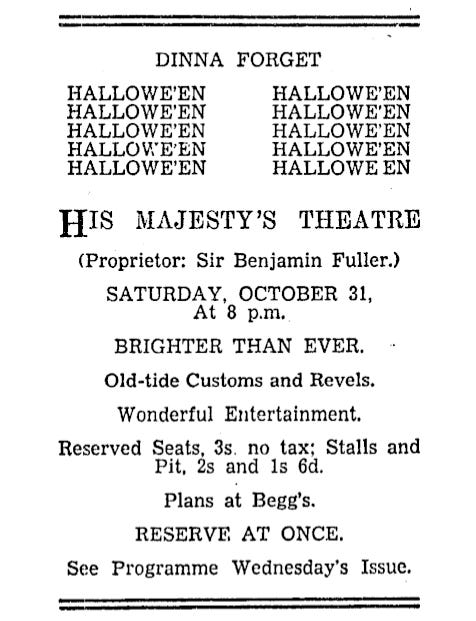
“The revival of the old Halloween ceremonies promises to be highly entertaining and humorous.” Reads a 1913 Evening Star article “The Burns Club have gone to great pains to carry out the various old customs and scenes, and everybody attending the Garrison Hall on Thursday night ‘should obtain a capital entertainment. The gathering concludes with a dance until midnight, and the club invite all present to join in.”
The specifically Scottish nature of Halloween was noted in media coverage of festivities over the following decade, with the Nelson Evening Mail noting in 1929 that the “old festival” had “survived mainly in Scotland”. A 1931 article in the Dominion headlined SCOTTISH FESTIVAL Halowe’en Observance described Halloween as “falling into neglect” suggesting that if not for being immortalised by Burns’ poem, “would probably have ended fully half a century ago.” Before noting that “In the lands of the British Empire, many of the Scots’ societies give entertainment on Hallowe’en”.
But it was not just the British Empire where Halloween spread, but anywhere that there was a diaspora from Scotland and the other Celtic countries where the festival was celebrated. The New Zealand Herald in 1936 noted that “In some of the smaller cities of the United States Hallowe’en is observed as enthusiastically as the Fourth of July.”
Halloween survived because participating in it was not limited just to the Celtic diaspora. Writing in 1937 for a regular column in the Northern Advocate called ‘Northland Tribe’ a (presumably Ngāpuhi) woman credited as ‘Princess’ said;
“I’ve never been to a Hallowe’en party, but from what I’ve heard, they must be fun. Imagine dim lights and witches, pumpkin heads and fortune-telling, with apple peeling and fire-sparks and such-like exciting things…I don’t much like the look of the beasties that’s coming out of the cauldron. Let’s hope that, like the Taniwha, he’s much nicer than he looks. Happy Hallowe’en, Northlanders, and very good luck”
It appears the specifically Celtic origins of the holiday were fading from memory by the mid 20th century. In a 1958 article published in Christchurch’s Press, Gardner Miller wrote that on October 31st “There will be Halloween parties among the younger folk who are fast forgetting, if ever they knew, the ancient traditions and trappings of an annual festival that distinguished the Celtic race from all others.”
Three years later The Press was educating readers on the Pagan origins of Halloween, which contains traces of Roman harvest festivals and the Celtic festival of Samhain (pronounced SAH-win an Irish word meaning “summer’s end”) the time where the boundary between the world of the living and the world of the dead was thinnest. When Christianity spread to the Celtic countries, pagan festivals were incorporated and October 31st, the day before all souls day, became All Hallows’ Eve, the first day of Allhallowtide, a three-day period of reflection on saints, martyrs, and the departed. Quoting from the Encyclopedia Britannica, The Press suggests that increasing secularisation had led to Halloween losing its spiritual dimension;
“The secular character of contemporary culture is also reflected in the public neglect of the religious significance of Hallowe’en, as well as in progressive loss of its folk vitality. Children are least affected by this disenchantment, and consequently the more important folk occasions tend to be dominated by the young.”
Indeed, two decades on The Press had dispensed with origin stories and was advertising activities for children with a short brief opening telling readers “In ancient times Halloween was a night of real terror, but people do not believe in evil spirits any more, and it has become a spookish fun night.”
Trick or Treat?
What about trick or treating? Dookin’ for apples is one thing but surely this is an undesirable Americanism? Not quite. The phrase “trick of treat” originated in North America- though in Canada, rather than the USA- but it evolved from two far older Samhain and Allhallowtide traditions. Souling, the medieval practice of exchanging small cakes for prayers (which itself was adapted from earlier Celtic traditions) and guising, where children would dress as malevolent spirits in order to blend in with any actual spirits that happened to be wandering the earth, and remain safe from harm.
A 1931 article in the Wairarapa Daily Times records that “We have no recollection of it [guising] being practised in Masterton, though it was fairly common in Dunedin sixty or seventy years ago.” This would place the practice around the same time, or possibly even earlier, than it arrived in North America. The phrase “trick or treat” may have spread across the English speaking world, and the carved pumpkin jack-o-lantern may have superseded the hollowed-out turnip with a flickering candle inside (said to represent a soul trapped in purgatory) but at its root, Halloween is a shared heritage wherever a Celtic diaspora is present. The disposable plastic treat buckets and costumes of modern Halloween may be off-putting, but if over-commercialisation of a once significant spiritual holiday is upsetting, wait until you hear about Christmas.
Halloween is changing in North America too. In Mexico, children go door to door in costume but rather than trick or treat they ask “¿Me da mi calaverita?” in English, “Can you give me my little skull?” requesting a (often intricately decorated) sugar skull. Decorated skull motifs have featured indigenous Mexican art for thousands of years, dating back to the Aztecs. Following the Spanish conquest of Mexico, the calaverita was later incorporated into celebrations for All Saints’ Day and All Souls’ Day, Día de Muertos. This is not entirely dissimilar to how Celtic traditions were incorporated into these same holy days when Christianity spread in Scotland and Ireland centuries earlier.
As Mexican immigrants and their descendants in the United States continue Día de Muertos celebrations, the country is in a round-about way returning to the three day long Allhallowtide, but a modern, secularised version that has been shaped by the interaction of different cultures. With the global spread of American media, these Mexican influenced traditions will possibly reach our shores (arguably it’s already beginning- see the 2017 Pixar film Coco) but would that be so terrible?
Halloween to me is a multiculturalism success story. A festival kept alive by diaspora groups through Burns Clubs and Caledonian Societies, which has evolved and adapted in large part because people in the wider community were invited to participate. We’re likely at the earlier stage of something similar happening with the festivals new diaspora communities have brought to our shores. In a hundred years time, the way Diwali, Eid, and Lunar New Year are celebrated in Aotearoa will probably look different from how those celebrations look today, and that isn’t a bad thing.
So observe Halloween however you want, or don’t observe it at all, but don’t complain its American, because it belongs to all of us.